Pre-Emergency

Well –
I always start with this one fact:
That of the four siblings in our family only one finished college,
And his degree is in “Recreation”. . .
If you-see-how-I-mean . . .

His one answer
For all things philosophical
Comes from a tenet
Of that Doctrinal Inculcation:

That 90% of the Enjoyment of any given Event
Is ANTICIPATION . . .
<Ah, gee, what I see is this:
That 90% of the Terror of any given doleful event
Is in the DREAD . . .but leave that there>

What I am anticipatin’ is this:

I’M GONNA GO MEDIEVAL
On the crabgrass
With the Pre-Emergent,
But not for six-months, yet . . .

For the rest of Autumn,
I’ll wait and watch to see
If my overseed will have taken . . .
Then the lawn will go dormant,
Covered in snow, unseen . . .

Until Spring,
Which will then be the Season of Retribution
When I repay the humiliation of this last summer
When crabgrass ran rampant, wild, over all of the yard . . .
Now will I bring Lawn Order
Good & Hard.



most of the time we fail

“What a good actor–a real actor–is always trying to do is very difficult, almost impossible, so most of the time we fail. Most of the time I fail. Because what I’m after is perfection, truth, reality: Truth in art. This is exceedingly rare. It’s very, very hard to achieve and overwhelming to maintain. So I fail a lot. But if I keep reaching for that perfection, that connection to the script, to the actors, to the audience, I’m becoming a better actor. I’m growing. I’m doing the right work. If you find someone who claims they are always satisfied, always good, a professional who hits the marks, you are not looking at an actor. I’m not going to say what you’re looking at, but it’s not an actor. It’s not an artist. I’m going to say it: What you have is a performer. I am not a performer.” –Kim Stanley/Interview with James Grissom/1992/Photo of Stanley from the 1958 film “The Goddess”

Follies of God

Faulkner Failure

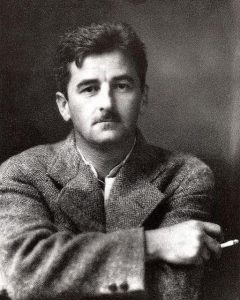
William Faulkner wrote The Sound and the Fury five separate times, “trying to tell the story, to rid myself of the dream.” “It began with a mental picture,” he told Jean Stein in 1956, “of the muddy seat of a little girl’s drawers in a pear tree.” He couldn’t seem to get it right, to find the picture’s grammar, or hear it. (According to Didion, “It tells you. You don’t tell it.”) This was part of the work, this getting it wrong—Faulkner believed failure was what kept writers going, and that if you ever could write something equal to your vision, you’d kill yourself.

The Paris Review

Poem Making Machine (The Singularity is Upon Us)

AI Poetry( New Yorker)

“Here is a Langston Hughes poem about futuristic inventions:”

THE MACHINE AGE

When machines take hold of flesh and blood
And hurl it through the stratosphere,
The time will come for the mind of man
To turn to the heavens for its meat
And its wine.
When machines take hold of the seed of life
And ripen a thousand harvests in one season,
The time will come to think of the soul
Of man.
When machines take hold of everything
And there’s nothing left to take,
The time will come to face
The God of nothing

And pray.

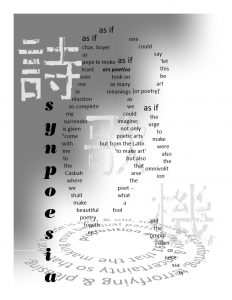
SYNPOESIA = Poetry Machine

Why Failure is Necessary for Creative Growth (Lithub)

why failure is necessary

Brandon Stosuy on Making Space for Mistakes and Setbacks

Even the most accomplished people deal with failure and ongoing self-doubt. You have to learn how to deal with it. Failure is how you learn. If you see it as anything but a lesson, and project it onto your self-worth, you’ll crumble. That low self-worth takes up a lot of room in your head. You end up giving too much space to jealousy, bitterness, comparing yourself to your peers and that’s less room for the creative process to unfold. Failure and success are endlessly intertwined. Each step forward can included a number of steps back. Basically: you have to get over yourself and get over the fear of failure.

I, myself, have embraced my failure(s).  Like all things, failure exists in an artificial duality, wherein we ignore the temporal criteria that may affect our evaluation, avoiding that pitfall, reconciling the duality into a oneness with success, is my method. I do not feel even the compunction to learn from failure, or do better, only to do and to keep doing.

Ah! Is to not-do the only real failure? I refer back to the wisdom of Tomiki, “The Way lies in inaction, yet nothing is left undone”.