Month: June 2020
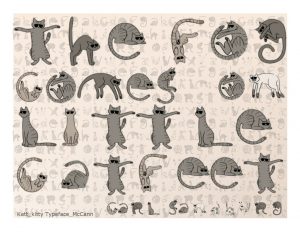
your father’s corpse
as Pound put it:
We are all Futurists to the extent of believing with Guillaume Appolinaire that
“On ne peut pas porter partout avec soi le cadavre de son pere”
(Gaudier-Brzeska, p. 94),
they did not agree with futuristic preoccupation with men and machines.<You can’t carry your father’s corpse everywhere with you>
ibid. A GUIDE TO EZRA POUND: 1885-1920 by lan Christie Clark, April, 1958, p. 122
i am trying not to rant about flannery o’connor, but . . .
racism, or not, of flannery o’connor, noted, or not
i admit this: that i don’t think that FoC is “all that” . . .
I think her notoriety is due to some sort of prejudice against southern intellectuals
that is, not that the critiques of her not well-thought-out or well-founded,
but rather that, in some reverse-twist
people adore her because her stories gratify
the worst expectations of southern mores & habitues;
in short, i think she is over-rated.
but then i have always thought willa cather was over-rated,
and so too, edith wharton,
so apparently there is some personal mendacity
i will have to deal with, sometime
so i will say no more on THAT.
but to what extent are the reputations of faulkner, percy, o’toole, et al
based upon the same sort of perverse prejudice?
i mean, i love these writers, for the southern-ness
with which i identify,
but i recognize (i perceive, i believe)
that others bulwark their regional prejudices
using the exact same ‘appreciation’.
if you see how i mean.
a partial scorecard,
excluding the most obvious human failings
of ‘great’ authors, such as misogyny & drunkenness,
pound was a fascist-sympathizer,
wodehouse was a fool,
kipling was an imperialist,
kerouac was a tool,
sandburg was a communist,
kundera was a stool . . .
THAT is enough of THAT . . .8^D . . .
‘Reason is, and ought only to be the slave of the passions …’ – Hume
We are in the midst of a second Humean revolution. In his Treatise of Human Nature (1739-40), the Scottish philosopher David Hume argued that: ‘Reason is, and ought only to be the slave of the passions …’ By ‘passions’, Hume meant what we now call emotions. What gave him such faith in the passions that he could accept reason’s enslavement to them? Hume understood reason to be incapable of producing any action, and the passions to be the source of our motivations. So he insisted that we must attend to the passions if we want to understand how anything gets done. Much recent neuroscience has found that human rationality is weaker than is commonly presumed, and the emotions make it possible to make decisions by granting certain objects salience. Why does this second Humean revolution matter and what, if anything, can the second revolution learn from the first?
T.E. Hulm, Romantics
Hulme described literature as either
“romantic” or “classic.”
The romantic writer is at fault because of his assumption that
the human mind can approach a reality beyond the concrete
things of the external world. The romantic, by talking of soul
and of realities beyond those of the every day, suggests
comprehension in areas where none may exist. Such a mixing
of the known and the unknowable leads to fuzzy thinking and
feeling: Verse to them (the romantics] always means a bringing
in of some of the emotions that are grouped round the word infinite
••• I object to the sloppiness which doesn’t consider that a
poem is a poem unless it is moaning or whining about
something or other.
(Hulme, Speculations, pp. 126-127)
ibid. A GUIDE TO EZRA POUND: 1885-1920
With Special Emphasis on his Poetic Theory and Practice
by lan Christie Clark, April, 1958, p. 88
one sample of his Amygist poetry
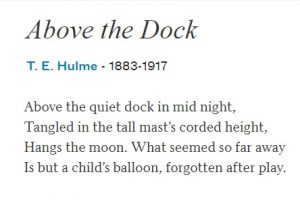
mehercule, per Ezra Pound
Personae of Ezra Pound (April 1909),
when perused by Ford’s critical eye, as Pound records:
••• displayed me trapped, flypapered, gummed and
strapped down in a jejune provincial effort to
learn mehercule, the stilted language that then
passed for “good English”in the arthritic milieu
that held control of the respected British
critical circles, Newbolt, the backwash of Lionel
Johnson, Fred Manning, the Quarterlies and the
rest of ’em. (‘Ford Madox Ford,’ p. 2)
Ford criticized his contemporaries for their stuffiness and
ivory towerism for he felt their art was divorced from reality. He
wished to see poetry written in a living language about contemporary
life and he wanted poetic communication to be as efficient as that
of prose. In a letter to Mrs. C.F.G. Masterman, a poetess who sent
him some verse in 1912, he wrote:
Your poetry should be your workaday life. That
is what is the matter with all the verse of to-day;
it is too much practised in temples and too little
in motorbuses ••• Literary! Literary!
Now that is the last thing that verse should ever
be, for the moment a medium becomes literary it is
remote from the life of the people, it is
dulled, languishing, moribund and at last dead ••• for what
the poet ought to do is to write his own mind in
the language of his day ••• you live in our
terrific, untidy, indifferent, empirical age, where not one
single problem is solved and not one single accepted
idea from the poet has any more magic ••• It is for us
to get at the new truths or to give new life to such
of the old as will appeal hominibus bonae voluntatis.
Only to do that we must do it in the clear pure
language of our own day and with what is clear and
new in our individuality.
(MacShane, p. 210)
Dante’s hendecasyllables
Once in Sicily, I came upon a century old Italian
school-book containing intelligent remarks upon
metric ••• the author did not ‘lay down rules,’ he
merely observed that Dante’s hendeca-syllables
were composed of combinations of rhythm units of
various shapes and sizes and that these pieces
were put together in lines so as to make, roughly,
eleven syllables in all ••• I had discovered this
point for myself in Indiana twenty years before
and in my own work had made use of the knowledge
continuously ••• This system represented versification when it was in a healthy state, when motz had not been divorced from son.
(“Cavalcanti,” p. 169)
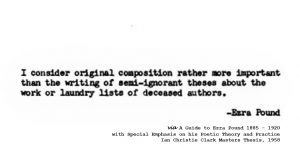
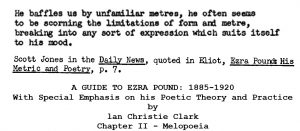
“il miglior fabbro”
A GUIDE TO EZRA POUND: 1885-1920
With Special Emphasis on his Poetic Theory and Practice
lan Christie Clark Master’s Thesis
April, 1958
In his discussions of individual poets, Pound deals at length with technical considerations; their skill in rhymes, their use of onomatopoeia, and their skill in blending sound with meaning. Arnaut Daniel particularly intrigued Pound. A poet who wrote in a decadent era, when chivalric song had lost its vitality, Daniel responded to the challenge by experimenting with and developing new techniques, until he earned the name given him by Dante, “il miglior fabbro” (Purgatorio, XXVI, 117). Daniel’s record is impressive, for he foresaw the sonnet; in “Sol Sui” he experimented with a form of blank verse; he invented the sestina; he employed “rima equivocas” (rhyming of words of equivalent sound but different meaning) (Casper, p. 203). In his poetry as songs, he built large musical structures, often rhyming from stanza to stanza, rather than within a given stanza. Most importantly, it was Daniel who taught Pound to use the musical phrase as a rhythmic sequence, and thus indicated one mode of escape from the iambic tyranny of standard English verse. Such were the practical lessons Pound was learning from his studies, and attempting to demonstrate in his own writing. We have only to compare Pound’s early efforts to write in the manner of Provence with his later attempts when his technical virtuosity was proven, and he had learnt the value of the chiseled phrase, to see how in fact Pound became an Arnaut Daniel for his own time, and earned the dedication of Eliot’s “Waste Land”.