Failed Poet
A GUIDE TO EZRA POUND: 1885-1920
With Special Emphasis on his Poetic Theory and Practice
lan Christie Clark Master’s Thesis
April, 1958
In his discussions of individual poets, Pound deals at length with technical considerations; their skill in rhymes, their use of onomatopoeia, and their skill in blending sound with meaning. Arnaut Daniel particularly intrigued Pound. A poet who wrote in a decadent era, when chivalric song had lost its vitality, Daniel responded to the challenge by experimenting with and developing new techniques, until he earned the name given him by Dante, “il miglior fabbro” (Purgatorio, XXVI, 117). Daniel’s record is impressive, for he foresaw the sonnet; in “Sol Sui” he experimented with a form of blank verse; he invented the sestina; he employed “rima equivocas” (rhyming of words of equivalent sound but different meaning) (Casper, p. 203). In his poetry as songs, he built large musical structures, often rhyming from stanza to stanza, rather than within a given stanza. Most importantly, it was Daniel who taught Pound to use the musical phrase as a rhythmic sequence, and thus indicated one mode of escape from the iambic tyranny of standard English verse. Such were the practical lessons Pound was learning from his studies, and attempting to demonstrate in his own writing. We have only to compare Pound’s early efforts to write in the manner of Provence with his later attempts when his technical virtuosity was proven, and he had learnt the value of the chiseled phrase, to see how in fact Pound became an Arnaut Daniel for his own time, and earned the dedication of Eliot’s “Waste Land”.
Australians’ general disinclination toward poetry had created an atmosphere conducive to the hoax. McAuley and Stewart, as well as Harris, reviled the nation’s philistines, whom Stewart and McAuley referred to as “Porlockers,” after the man from Porlock who interrupted Coleridge in the making of his unfinished masterpiece “Kubla Khan.” Harris once delivered a lecture entitled “Surrealism, the Philistines, and You,” and wrote a poem subtitled “Death is Non-Existent, Death is Bourgeois.”16 The Ern Malley “discovery” was exciting partly because of Australia’s perceived lack of culture and stagnancy in its poetry scene. Stewart and McAuley used this anti-philistine sentiment to their advantage, creating the figure of Ethel Malley, whose unsophisticated correspondences and indifference toward her brother’s work bore the mark of the provincialism Harris and the hoaxers despised. Her ignorance made her brother’s ingenuity even more striking, and Harris may have viewed himself as Malley’s literary savior, rescuing the manuscript from its fate in the hands of the ignorant Porlockers.
“Imp of Verbal Darkness”: Poetry Hoaxes & the Postmodern Politic
Do we simply intend those meanings, thereby willing them into existence? And if the human mind does tend to impose its intentions on a text, can any poetry be truly meaningless? If the idea is pushed far enough, poetry becomes a kind of Rorschach test, perhaps (as Michael Heyward suggests) proving Freud’s claim that it’s impossible to talk nonsense.31
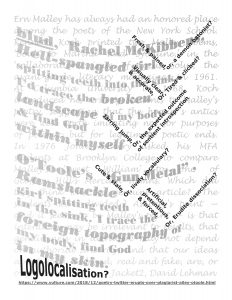
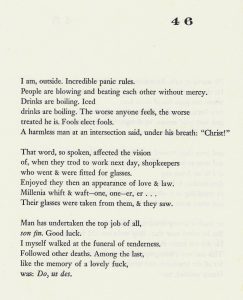
“ern malley”, from Opus in Progressu
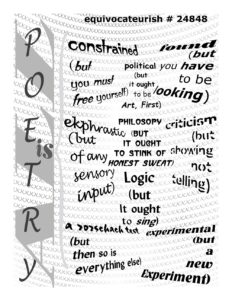
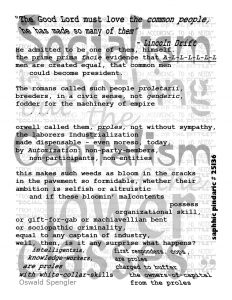
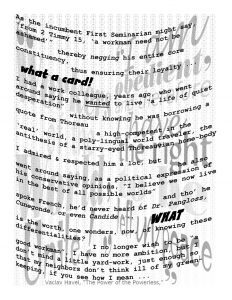
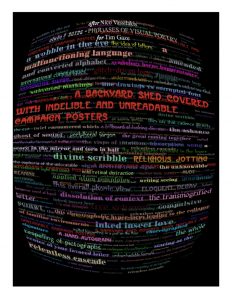
“equivocateurish # 24848”, from Max Nix