Author: admindavid
Writer Traits – Karen E. Bender – Lit Hub
If You Have These Traits You Might Be a Writer
Karen E. Bender
So first: there is the love of language. You are, after all, working with words. For writers, there is the sense that you don’t want to read a sentence or a description or a story—you want to eat it. You want to make love to it. You want to, above all, give birth to it—which is what each work is in response to another—a birth. You are affected deeply, in a physical way, when you read a sentence, a character, a story of a writer who you admire. You are obsessed with how.
This sensitivity toward language is what people refer to as “talent.” It is described in a sort of appropriating way: “She has talent.” I have always been suspicious of the word “talent” in writing. Yes, there must be sensitivity to language and an interest in words and image and story. Virginia Woolf, describing Shakespeare, says in her essay, “The Common Reader”: “(Shakespeare), the word-coining genius, as if thought plunged into a sea of words and came up dripping.”
. . .
First, yes, you need sensitivity to language.
And then the psychological traits that I believe are necessary to becoming a writer are:
a tendency toward extreme sensitivity,
openness to the imagination,
a particular stubbornness, and
a precise form of delusion.
American Bughouse / Left with Ludwig
 86 pages
an examination of the American landscape thru the dual prisms of Pound & Bukowski . . . we find both that Pound is more accessible than popularly thought and that Bukowski is deeper that popularly believed.
Cantos Poesia
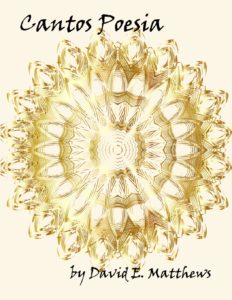 44 pages
Published by Unlikely Books
Intensely layered visual poems and textual art, including an afterword explaining Matthews’ unique vispo philosophy and technique.
 72 pages
v1
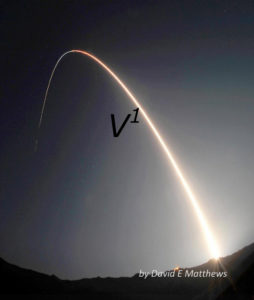 34 pages
poetic failure is common:
the leaden phrase
the clanky rhymes
the opaque metaphor
the clumsy meter
the misbegotten idees
indeed
all of my specialities
Better Late Than Never—Sez Who?
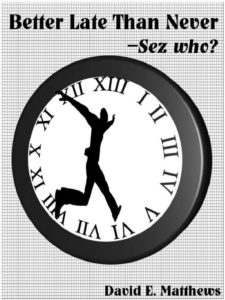 84 pages
An anecdotal re-entry into a life-long exploration of meaning and content, personal ruminations upon “lives of quiet desperation” that are the new American Dream.
My S-Word: 1972 – 1999
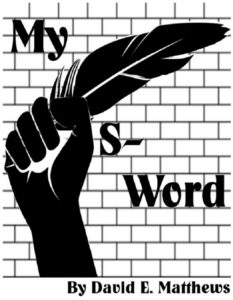 60 pages
Explorations and fragmentations in search of meaning beyond form and content.
beyond:
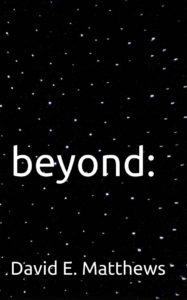 78 pages
first reports are often unreliable
they may be invented
like the warnings of ancient map makers
“beyond here be dragons”
but this where our inquiry must begin
 74 pages