seeking immortality
i googled
“how to download my self into my pc”
but
most of the results
concerned admin privileges
Author: admindavid
lubricants
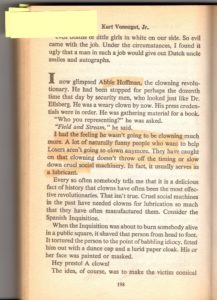
Vonnegut, Wampeters, Foma, & Granfalloons, “In a Manner That Must Shame God Himself”
Jon Stewart, Colbert, John Oliver, et al . . .
always filled me with a vague disquiet
even while i laughed . . .
now i know why
after re-reading this book
which i confess is so formative
to my understanding of things
they are lubricating us for our appt with destiny
white rabbit fever
French critics mostly read The Plague, which, after many deaths, ends by defining “plague” as “just life, no more than that,” as It was also understood as an allegory of the German occupation, with France separated from the West—although the references to crematoria and concentration camps scattered throughout have intimations of something more.
https://www.theparisreview.org/blog/
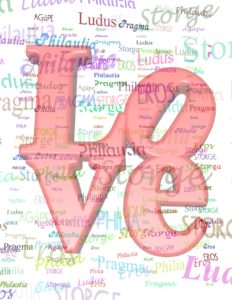
7 kinds of love
i don’t know when,
i don’t know why,
i barely know how . . .
Nothing is Real – Jenn Zed

one of my imaginary internet friends, Jenn Zed . . .
this seems to me an excellent book cover, for which i have no book, dangit . . . 8^D . . .
she must be building up to a gallery show, i hope she is,
this series Nothing is Real seems very special
Jane Hirshfield – O M G
I first met Jane Hirshfield about fifteen years ago, after one of her readings in San Francisco. She reads her poems with intensity, but not loudly. Her voice is even, quiet. I was struck by the many tonalities of her silences. Still, there is a distinctly recognizable passion in her quiet moments. Speaking with her, I was fascinated by how much I was able to gather from the moments between her sentences, by the way those sentences follow one another, surprising at each turn. This is also true of her poems: reading her work, I catch myself thinking that Hirshfield is the poet who orchestrates silences, which is perhaps fitting for someone who says that her medium is lyric poetry. It isn’t easy these days to find a poet who can do this while being also perfectly articulate and clear. Reading Hirshfield, I find myself coming back to Mahmoud Darwish’s idea that clarity is our ultimate mystery.
(Paris Review)
For What Binds Us
BY JANE HIRSHFIELD
There are names for what binds us:
strong forces, weak forces.
Look around, you can see them:
the skin that forms in a half-empty cup,
nails rusting into the places they join,
joints dovetailed on their own weight.
The way things stay so solidly
wherever they’ve been set down—
and gravity, scientists say, is weak.
And see how the flesh grows back
across a wound, with a great vehemence,
more strong
than the simple, untested surface before.
There’s a name for it on horses,
when it comes back darker and raised: proud flesh,
as all flesh,
is proud of its wounds, wears them
as honors given out after battle,
small triumphs pinned to the chest—
And when two people have loved each other
see how it is like a
scar between their bodies,
stronger, darker, and proud;
how the black cord makes of them a single fabric
that nothing can tear or mend.
write less often — NYTIMES
Absence makes the heart grow fonder. That’s the cliché anyway. And, of course, it’s cliché for a reason — a hard-wired, psychological reason known as scarcity.“The principle of scarcity indicates that people want more of what they can have less of,” said Robert Cialdini, Regents’ professor emeritus of psychology at Arizona State University and author of “Influence: The Psychology of Persuasion.”“Things that are rare, scarce, dwindling in availability become more attractive as a consequence of perceived value,” he said.
your colleagues dont read what you write — NYTimes
OF COURSE this is pointed at business communication
but for me, poetry and business communication intersect
if you can visualize the venn diagram, you know what i mean . . .
i have been writing free verse memos & emails for years now, nobody ever noticed
i won’t bore you with an example —
i have been making projective-verse powerpoint presentations for year now, nobody ever noticed
here is a sort of an example:
Stand-alone Granular Awareness
- Hybrid Frictionless Options
- Customized Service-oriented Action-items
- Responsive Design Analysis
- Functional Logistical Thinking
- Integrated Digital Campaign
- .@#$%¬* Reciprocal Capability
- Deployable One-to-many Flexibility
- Co-operative Inferential Workstream
- Poly-synchronous Political Brain-storming
- Systemized Multipartite Time-line
- Agile Cultural Agility
- Robust Policy-driven Roadmap-to-success
- Utilization Team-oriented Estimate
- Grown Transitional Co-efficients
- Cultivated Organizational Spit-balling
- Iterative Enterprise API
- Symbiotic Budgetary Problem-solving
- Auto-generated Economic Relationships
Thank you for your attention !
but i believe in a totally integrated intellectual environment
that is, HOW i am making my way thru the material world
is part-and-parcel of my aesthetic
Eric Blair
I became a huge fan of Eric Blair my freshman year in high school.
First, when this rowdy young cowboy, a friend of a friend, nudged me in study hall, which we chose to spend in the Library, nudged me with a lascivious leer and pointed to his book, I couldn’t imagine what kind of book, but he showed me, by where he pointed. I read
War is Peace.
Freedom is Slavery.
Ignorance is Strength.
Wow.
Second, when we read “Shooting an Elephant” in class, and I couldn’t believe it was assigned reading,
I couldn’t believe it was so subversive. So I read the rest of his books, and the essays, of course.
In one book of essays, he writes about his first stirrings as a writer. He would describe the action as if in a book, for practice: “…he entered the room, and turned to look at the encyclopedias…”. Well, once such an ongoing personal self-narrative like that got established, it can’t just be shut off. Soon such a person would see himself differently, refer to himself in the third person, assume an odd pseudonym, like George Orwell.
*
In one of his books Marshall McLuhan wrote about the Bali islanders. In order to export for sale some indigenous art,
the native artists were asked to make crates for the art. It took them as long to make the crates and it did the art.
When asked why they said, “We don’t have any art, we do everything the best we can.”
*
For years I’ve been writing anonymous documents, meeting minutes, proposals, incident reports, as the best I could.
I will claim this: I might have written something down wrong, or someone might have disagreed with what I have written, but everyone understood what I had written.
*
So now I claim I’m a poet
*
Yes, I claim to be a McLuhanistic Orwellian Poet. I never don’t write Poetry.
***
poetry for me exists in that gray area, the venn overlap, where
because noone really wants to read anything, they are so overwhelmed
communication is encouraged to be concise:
in business, it must be brief AND understood . . .
in poetry
to the point where one-word asserts it has poeticity,
where fragmented projective-verse, dada, palimpsests are accepted
understanding is not required (or at least, not a single understanding)
i am not suggesting anyone else write less,
this is just for my own consideration . . .
addenda
i am not suggesting anyone else write less,
this is just for my own consideration . . .
writing less might mean less discrete works of poetry,
or it might mean smaller works of poetry
the age of electronic & social media,
whether one considers it a symptom of, or a cause of,
indicates the shrinking attention span – –
the age of trump,
whether one considers him an outlier of bad faith, or
merely the most obvious example of regressive tendencies
indicates the simplification & tersification
of communication
so to speak in the age of social media & trump
what should be the response of the poetic aesthetic?
one response might be to create in smaller bites
opuscules
symptomatic of this response
might be the rising interest
haiku, senryu, if you see how i mean
or even one-word poems
or picture-worth-1000-words epigrafix . . . 8^)
or classic forms that fit on one page, eg. sonnets
or new forms —
to deal entirely with a open-hand
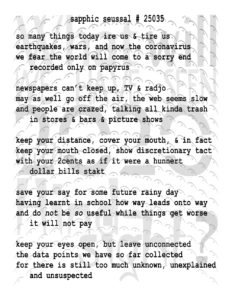
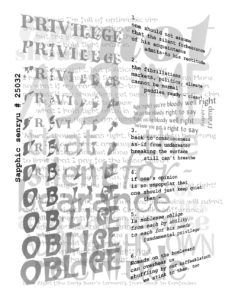
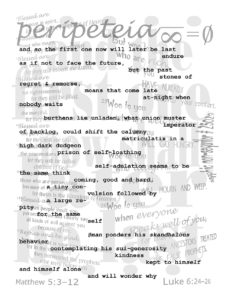
i am experimenting with hybrid opuscules, now
based on the sapphic stanza
writing smaller