Author: admindavid
Readymade Writing @NERO (Kenneth Goldsmith)
Vincenzo Santarcangelo: You studied sculpture at college. It seems, however, that you have no interest in shaping language: “We don’t need the new sentence, the old sentence re-framed is good enough” is one of your mottos. Do you think any trace of those years of apprenticeship has remained in your work, in some way?
Kenneth Goldsmith: When we shift linguistic contexts from one place to another, we shape them, hence Marcel Duchamp’s reassignment of found objects; if Duchamp could do that with sculpture and John Cage could do that with sound, then I thought that I could do it with language. While we tend to emphasize the semantic qualities of language, certain strains of modernism taught us to value their formal qualities as well, the audio and visual aspects of language. In the digital age, language can literally be picked up and moved via cut-and-paste, making it extremely physical. It can also be displaced à la Duchamp (think of how you share, say, an Instagram photo, providing recontextualization each time it is viewed); in this way, we can say that the entire Internet is one big Duchampian readymade.
NERO (imvho interesting even if in the end totally wrong . . .


Recreation of a memory of a west Texas matron of Manhattan from the Top of the Sixes
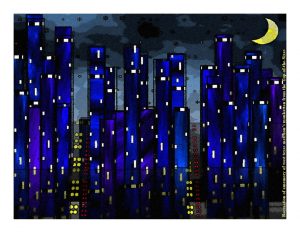
I remember a dinner party my Mother gave in my pre-teen years: she dressed us three boys as waiters and taught us waiting protocol; she drew a huge city-scape in chalk and hung it on the wall like a window onto downtown Manhattan. In my recollection that mural astonishes me with its competence and beauty
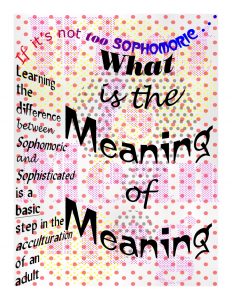
Life’s purpose comes from our minds’ amazing ability to extract meaning from the world
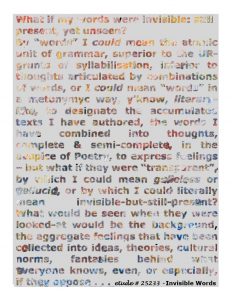
Take words, for instance, those mesmerising language units that package meaning with phenomenal density. When you show a word to someone who can read it, they not only retrieve the meaning of it, but all the meanings that this person has ever seen associated with it.
They also rely on the meaning of words that resemble that word, and even the meaning of nonsensical words that sound or look like it.
And then there are bilinguals, who have the particular fate of having words in different languages for arguably overlapping concepts. Speakers of more than one language automatically access translation in their native language when they encounter a word in their second language.
Not only do they do this without knowing, they do it even when they have no intention of doing so.
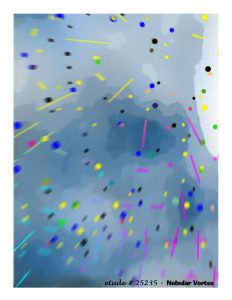
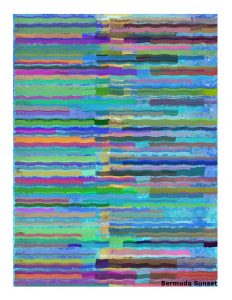
Recently, we have been able to show that even an abstract picture – one that cannot easily be taken as a depiction of a particular concept – connects to words in the mind in a way that can be predicted.
It does not seem to matter how seemingly void of meaning an image, a sound, or a smell may be, the human brain will project meaning onto it. And it will do so automatically in a subconscious (albeit predictable) way, presumably because the bulk of us extract meaning in a somewhat comparable fashion, since we have many experiences of the world in common.